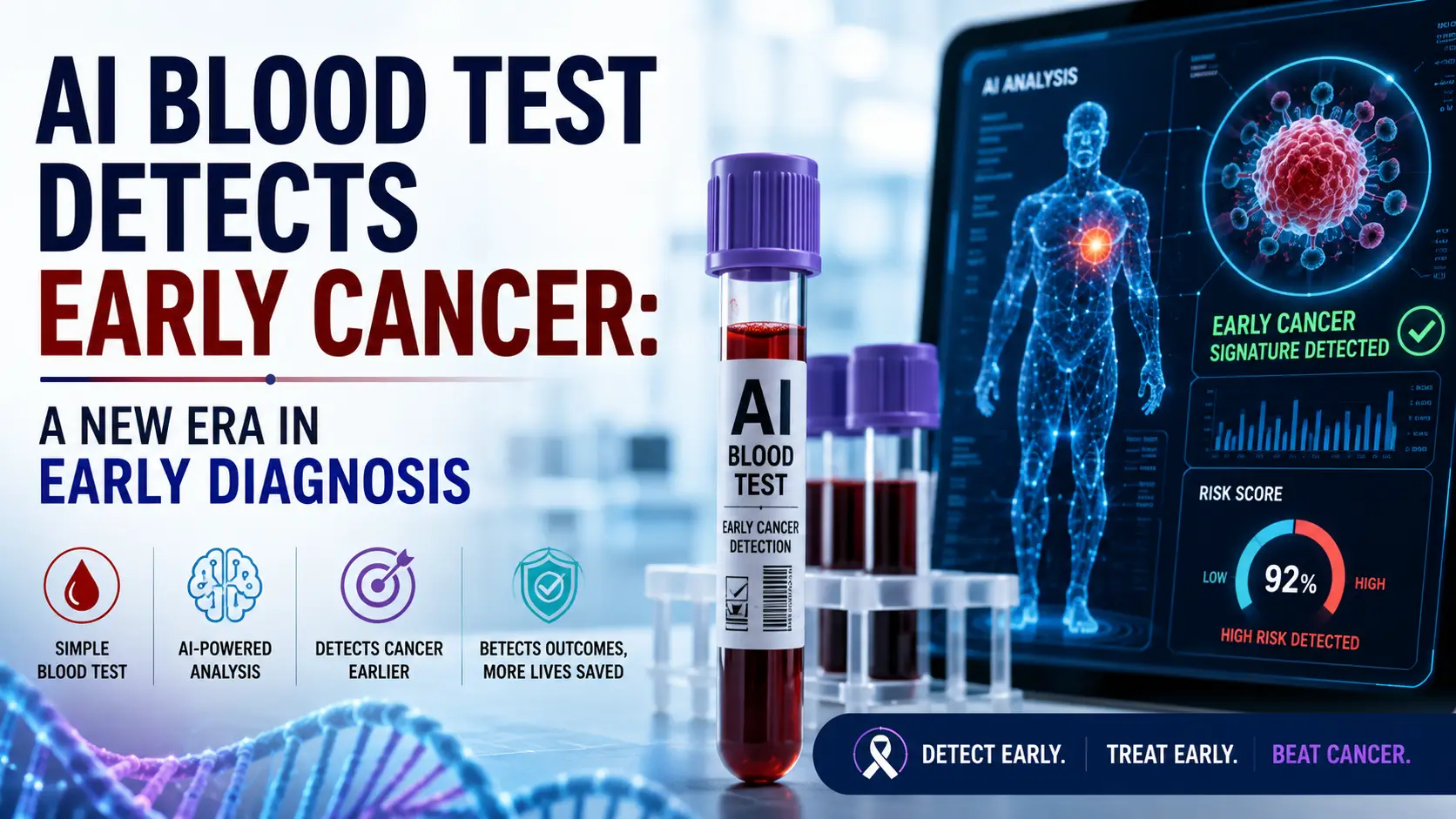
Artificial intelligence is transforming cancer detection, and one of the most promising breakthroughs is the development of AI-powered blood tests capable of identifying cancer at its earliest stages. These advanced tests analyze tiny fragments of DNA, proteins, and other biomarkers circulating in the bloodstream, allowing doctors to detect signs of cancer before symptoms appear.
Researchers believe this technology could significantly improve survival rates by enabling earlier diagnosis and faster treatment, potentially changing the future of cancer screening worldwide.
How the AI Blood Test Works
Unlike traditional cancer screening methods that often focus on a single organ, AI blood tests examine a simple blood sample for biological signals associated with multiple types of cancer.
The test combines advanced laboratory techniques with artificial intelligence algorithms that analyze:
- Cell-free DNA (cfDNA)
- Circulating tumor DNA (ctDNA)
- DNA methylation patterns
- Proteins and other biomarkers
- Genetic mutations linked to cancer
The AI system compares these patterns with millions of data points from previous patients to identify abnormalities that may indicate cancer.
Detecting Cancer Before Symptoms
One of the biggest advantages of AI-based blood tests is their ability to detect cancer long before symptoms develop.
Many cancers, including pancreatic, ovarian, liver, lung, and colorectal cancer, often remain unnoticed until they reach advanced stages. Early detection dramatically increases treatment options and improves survival rates.
Researchers hope AI blood tests will eventually become part of routine health check-ups, helping identify cancers when they are still highly treatable.
Multiple Cancers From One Sample
Unlike conventional screening tests, which usually detect only one specific cancer, many AI blood tests are designed to identify dozens of different cancer types simultaneously.
Current research has focused on detecting cancers such as:
- Breast cancer
- Lung cancer
- Colorectal cancer
- Liver cancer
- Pancreatic cancer
- Ovarian cancer
- Stomach cancer
- Prostate cancer
Some experimental tests can also predict the most likely organ where the cancer originated, helping doctors decide which diagnostic scans should be performed next.
The Role of Artificial Intelligence
Artificial intelligence is essential because the biological changes associated with early cancer are often too subtle for traditional analysis.
Machine learning models are trained using enormous datasets containing blood samples from both healthy individuals and cancer patients. Over time, these algorithms learn to recognize extremely complex molecular patterns that may indicate disease.
As more clinical data become available, AI systems continue to improve their accuracy and reduce false-positive and false-negative results.
Benefits Over Traditional Screening
AI blood tests offer several advantages over conventional screening methods.
These include:
- Simple blood sample collection
- Earlier detection of cancer
- Ability to detect multiple cancers at once
- Less invasive than tissue biopsies
- Faster laboratory analysis
- Potential for routine population screening
Because the test requires only a blood sample, it may also improve participation among people who avoid invasive procedures such as colonoscopy or tissue biopsy.
Current Challenges
Although the technology is highly promising, experts caution that AI blood tests are still evolving.
Several challenges remain before they become routine healthcare tools:
- Large-scale clinical validation
- Ensuring consistent accuracy across different populations
- Reducing false-positive results
- Determining cost-effectiveness
- Regulatory approvals in different countries
Doctors also emphasize that a positive blood test does not confirm cancer. Additional imaging tests and biopsies are still required to establish a definitive diagnosis.
Future of Cancer Screening
Researchers believe AI blood testing could become one of the biggest advances in cancer detection over the next decade. Instead of waiting for symptoms to appear, healthcare systems may eventually use annual blood screening to identify cancers at their earliest stages.
Scientists are also exploring whether AI can monitor cancer recurrence after treatment, assess treatment response, and personalize therapies based on molecular changes detected in blood.
As artificial intelligence continues to evolve, its integration with precision medicine is expected to improve both diagnosis and patient outcomes.
A Major Step Toward Earlier Detection
AI-powered blood tests represent a significant breakthrough in modern cancer research. By combining advanced molecular biology with machine learning, these tests offer the possibility of detecting cancer earlier than ever before using only a simple blood sample.
While more clinical studies and regulatory approvals are still needed, the technology has the potential to transform cancer screening by making early detection faster, less invasive, and more accessible. If successfully implemented on a large scale, AI blood tests could save countless lives through earlier diagnosis and timely treatment, marking a new chapter in the global fight against cancer.
Leave a Reply