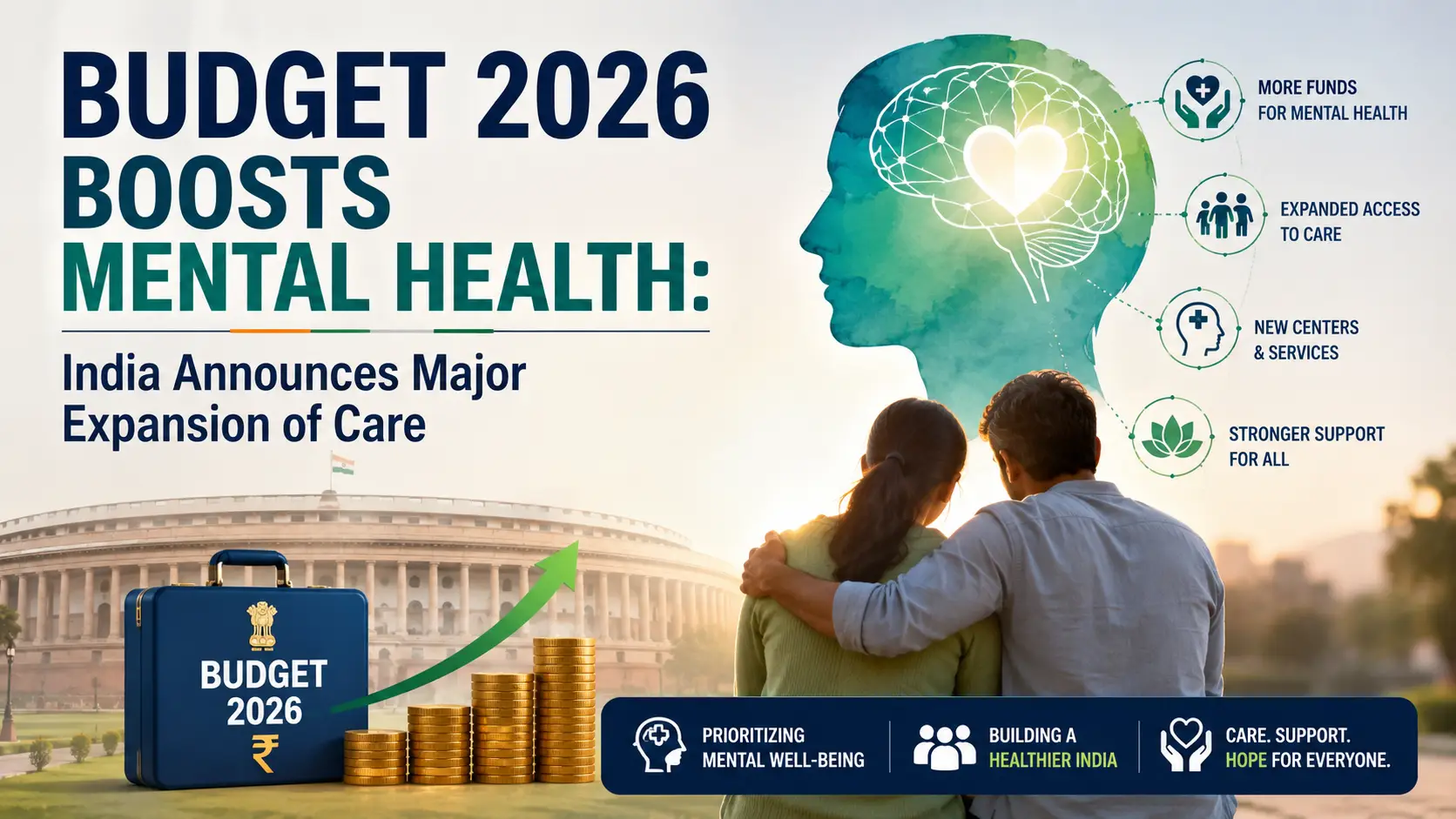
Mental health emerged as one of the standout healthcare priorities in the Union Budget 2026-27, with the Government of India announcing a significant expansion of mental healthcare infrastructure. The budget introduces new institutions, upgrades existing facilities, and aims to improve access to quality psychiatric care, particularly in underserved regions of the country.
The announcement reflects growing recognition that mental health is an essential component of public healthcare. Rising cases of anxiety, depression, stress-related disorders, substance abuse, and suicide have highlighted the urgent need for stronger mental health services. Through Budget 2026, the government seeks to bridge longstanding gaps in infrastructure and specialist care while making mental health services more accessible for millions of Indians. (Press Information Bureau)
Mental Health Takes Centre Stage
For the first time, mental healthcare received dedicated attention as a major healthcare priority during the Union Budget presentation. Finance Minister Nirmala Sitharaman announced plans to strengthen India’s mental health ecosystem by expanding national institutions and improving regional access to specialised treatment.
A key announcement is the establishment of NIMHANS 2.0, a new national-level mental healthcare institute in North India. The government also announced the upgradation of the National Mental Health Institutes in Ranchi and Tezpur into regional apex centres to improve access to advanced psychiatric care outside southern India. (Press Information Bureau)
Why the Expansion Is Important
Mental health experts have long pointed out that India faces a severe shortage of psychiatrists, psychologists, psychiatric nurses, and mental health facilities. Large sections of the population, particularly in rural and semi-urban areas, have limited access to specialised treatment.
Until now, the National Institute of Mental Health and Neurosciences (NIMHANS) in Bengaluru has served as India’s premier mental healthcare institution. However, patients from northern and eastern states often travel long distances to receive advanced treatment.
The new institutions announced in Budget 2026 are expected to reduce regional disparities by bringing specialised services closer to millions of people. (Wikipedia)
Improving Healthcare Infrastructure
The Budget focuses on strengthening mental healthcare infrastructure rather than only increasing financial allocations. The proposed expansion includes:
- Establishment of NIMHANS 2.0 in North India.
- Upgrading Ranchi and Tezpur mental health institutes into regional centres of excellence.
- Expansion of emergency and trauma care facilities linked with district hospitals.
- Improved training capacity for psychiatrists and mental health professionals.
- Better access to specialised diagnosis and treatment services across multiple regions. (Press Information Bureau)
Health experts believe these measures can help reduce waiting times, improve treatment quality, and expand specialist availability across the country.
Addressing India’s Mental Health Burden
India continues to face a significant mental health burden, with millions of people living with depression, anxiety disorders, bipolar disorder, schizophrenia, and substance-use disorders. Despite growing awareness, treatment gaps remain high because of stigma, lack of awareness, and limited healthcare infrastructure.
Many patients delay seeking medical help due to fear of discrimination or because specialised services are unavailable in their district. The Budget’s emphasis on expanding institutional capacity aims to improve both accessibility and quality of care.
The government’s approach also supports long-term research, professional training, and community outreach programmes designed to encourage early diagnosis and timely treatment. (Press Information Bureau)
More Than Just Hospitals
Experts say expanding hospitals alone will not solve India’s mental health challenges. Public awareness, school counselling, workplace wellness programmes, tele-mental health services, and community-based interventions will remain equally important.
Digital mental healthcare initiatives, counselling helplines, and integration of mental health services into primary healthcare are expected to complement the new institutional infrastructure over the coming years. Combined with improved training for healthcare workers, these measures could significantly strengthen India’s overall mental healthcare system. (Press Information Bureau)
Challenges That Still Remain
While the Budget announcements have been widely welcomed, experts caution that infrastructure expansion must be supported by adequate staffing, funding, and implementation. Several states continue to experience shortages of psychiatrists, clinical psychologists, psychiatric social workers, medicines, and specialised equipment.
Recent audit findings in some states have highlighted persistent gaps in public mental healthcare, reinforcing the need for sustained investment beyond infrastructure alone. (The Times of India)
A Positive Step Forward
The Union Budget 2026 marks an important shift in India’s approach to mental healthcare by recognising mental well-being as a national healthcare priority. The creation of new institutions, regional expansion of specialist services, and investment in healthcare infrastructure demonstrate a stronger commitment to addressing one of the country’s most pressing public health challenges.
Although improving mental health outcomes will require continued investment, trained professionals, and greater public awareness, the Budget lays a stronger foundation for expanding access to quality psychiatric care. If implemented effectively, these initiatives could help millions of Indians receive earlier diagnosis, better treatment, and improved long-term mental well-being while reducing the country’s longstanding mental healthcare gap. (Press Information Bureau)
Leave a Reply